
Choosing construction fabric by price or natural-fibre content can create failures during monsoon runoff, concrete curing, or soil movement. You will be able to match jute, coir, polypropylene, polyester, canvas, burlap, and erosion-control blankets to the required service life, then specify and install the selected material correctly.
Key takeaways
- Choose jute when planned biodegradation matters more than long-term reinforcement.
- Specify fabric weight, weave, roll size, tensile strength and biodegradation period.
- Use pegs, overlaps and anchoring to prevent monsoon runoff from lifting jute fabric.
- Reject suppliers who cannot provide samples, test reports and consistent batch details.
How Jute Compares with Geotextile, Coir and Other Construction Fabrics
Jute fabric versus other materials for construction in Nagpur depends on the failure you must prevent. Choose jute when planned disappearance matters; choose polypropylene or polyester when filtration, separation, reinforcement, or drainage must work for years.
| Material | Strength, tear and puncture behaviour | Water, UV and biological behaviour | Best construction use |
|---|---|---|---|
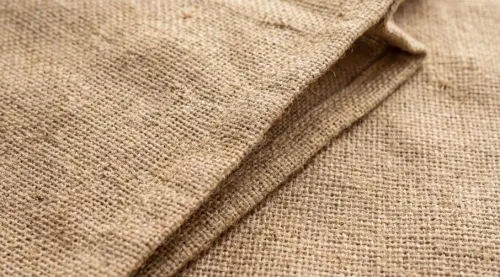
| Woven jute | Moderate dry tensile strength; low-to-moderate elongation, tear and puncture resistance | Permeable, absorbs water, tolerates limited UV exposure, then loses strength through wetting, microbes and decay | Temporary erosion control, sediment trapping, mulch support and slope cover |
| Coir | Lower initial tensile strength than many jutes but greater elongation and resilience; good surface roughness | Highly permeable, absorbs water, tolerates wet exposure better, biodegrades slowly | Longer-lasting biodegradable erosion control |
| Woven polypropylene | High tensile, tear and puncture resistance; low elongation | Low water absorption, UV treatment required, resists soil microbes and biodegrades very slowly | Durable separation, filtration and reinforcement |
| Polyester geotextile | High tensile and puncture performance; controlled elongation | Low absorption, strong UV and microbial resistance when specified correctly | Long-service filtration, drainage and soil reinforcement |
| Cotton canvas | Stronger and tighter than burlap, but variable tear resistance | Absorbs water, supports microbial decay, poor permanent soil performance | Temporary covers and site protection |
| Burlap | Coarse, inconsistent strength; packaging grades tear easily | Absorbs water and decays quickly | Mulch, wrapping or short-term cover—not geotechnical reinforcement |
| Nonwoven erosion-control blanket | Fibre entanglement gives surface coverage, not structural tensile reinforcement | Permeable, absorbs water according to fibre, biodegradability depends on fibre | Temporary runoff and sediment control |
Construction-grade jute has declared GSM, weave, tensile results and treatment; ordinary packaging burlap does not. Dry tensile strength alone cannot justify permanent soil reinforcement because wetting and biological exposure reduce capacity. This natural construction fabric comparison points to jute for temporary service, not permanent geotechnical duty.
Match the Fabric to the Construction Job and Required Service Life
Jute fabric for construction projects is suitable for temporary erosion control where runoff must slow, sediment must settle, and vegetation will take over. Use woven jute on slopes, embankments, drains, landscaping, temporary soil cover, surface protection, mulch support, and short-term dust control.
| Job | Use jute when | Choose another material when |
|---|---|---|
| Temporary erosion control | A six-to-24-month service period is a design starting point and biodegradation is acceptable | Erosion control must remain effective for years |
| Concrete curing | Wet hessian or burlap stays continuously moist, prevents rapid drying, and is removed after curing | The cover may dry out; dry burlap can draw water from concrete and contribute to shrinkage or surface cracking |
| Drainage separation | Not the primary function | Use a filtration and separation geotextile designed for sustained permeability |
| Slopes and retaining works | Surface runoff, not structural stability, is the concern | Use engineered reinforcement, geogrid, anchors, or a retaining system for permanent tensile resistance |
| Waterproofing | Never rely on uncoated jute | Use a waterproofing membrane |
Unlaminated jute drains water and biodegrades faster. PP-laminated jute resists water and lasts longer, but reduces drainage, slows biodegradation, complicates cutting and fixing, and can trap water beneath the sheet. Select it only after checking the underside, outlet paths, and fastening method.
Wetting, microbes, UV exposure, burial, weave, and site disturbance can shorten the six-to-24-month assumption, so it is not a guarantee.
Which Fabric Specifications Belong in the Purchase Order?
Put these figures in the purchase order before approving construction fabric:
- Mass per unit area: GSM and, if used, ounces per square yard
- Weave type, yarn count, and confirmed mesh or opening size
- Tensile strength and elongation in warp and weft directions
- Tear resistance, puncture resistance, permeability, seam strength, and allowable dimensional variation
- Roll width, roll length, treatment or lamination, and moisture condition at dispatch
- Test method, specimen direction, specimen width, conditioning, units, and batch number
Two fabrics with the same GSM can perform differently. A heavier yarn with a loose weave behaves differently from finer yarns packed into a dense weave.
| Construction | Runoff and handling effect | Site consequence |
|---|---|---|
| Open weave | More airflow, drainage, and faster biodegradation; less sediment trapping | Better for temporary soil cover, but easier for concentrated runoff to bypass |
| Tight weave | Greater sediment trapping and handling stability; less airflow and drainage | Better surface control, but slower drying and decomposition |
Treat 9x9, 10x10, 11x12, 13x13, and 14x15 as unconfirmed notation. Ask whether each number means yarn count, ends and picks per unit length, mesh count, or another specification; do not approve a catalogue code alone.
For construction jute fabric in Nagpur, require wide-width tensile testing to ISO 10319 and erosion-performance evidence to ASTM D6460/D6460M where slopes or channels are involved. Record test direction and conditioning, because unconditioned warp results cannot be compared fairly with conditioned weft results.
How to Install Jute Fabric Through Nagpur’s Monsoon and Summer Conditions
Fix construction jute fabric in Nagpur with enough contact and anchorage to stop monsoon runoff lifting the sheet or bypassing its edges.
- Compact the slope, remove stones and roots, and grade hollows smooth.
- Keep rolls dry and off the ground until installation; do not lay damp, mouldy material.
- Lay each roll in the direction of flow, not across it. Press the fabric fully against the soil.
- Trench the crest and both side edges 150 mm deep, place the fabric inside, backfill, and compact.
- Overlap adjoining rolls by at least 300 mm. Stitch or tie seams where concentrated flow crosses them.
- Fix with U-pins or staples at 300 mm centres; use 150 mm centres at the crest, toe, seams, channels, and flow paths.
- Patch tears with a 300 mm-wide fabric piece extending beyond every damaged edge, then pin the patch densely.
Construction jute fabric in Nagpur needs closer fixing before intense monsoon storms. On black cotton soil, avoid stretching the sheet tight: shrink-swell movement can pull pins or open seams. Recheck after the first heavy rain and repair lifted edges immediately.
| Laminated versus unlaminated sheets | Site consequence |
|---|---|
| Laminated | Resists wetting longer, but can trap water beneath the sheet and slows decay |
| Unlaminated | Drains better and decays faster, requiring earlier vegetation establishment |
Shield exposed fabric from prolonged summer sunlight where possible. Remove it after vegetation establishes, or bury the remnants without blocking drains. Specify a one-season installation separately from one expected to survive several monsoons; the latter needs engineered durability evidence rather than dry tensile strength alone.
How to Vet a Jute Fabric Supplier Before Ordering in Nagpur
Before accepting a bulk delivery from a jute fabric supplier in Nagpur, approve a physical sample against a written specification.
Ask for batch identification, declared GSM, roll width and length, weave and yarn notation, tensile results in both directions, permeability data, seam strength, moisture condition, treatment or lamination details, degradation evidence, storage instructions, and installation guidance.
SP Jute Craft Enterprises can provide a local comparison point for custom bulk requirements, but the evidence must describe construction performance, not just a catalogue label.
- Match test method, specimen width, test direction, conditioning, and units before comparing figures. Record ISO 10319 or another named standard; otherwise, “tensile strength” comparisons are unreliable.
- Inspect every sampled roll for inconsistent weave, damaged edges, oil or sizing residue, dampness, mould, and undocumented substitution with packaging cloth. Ordinary sack hessian is not construction-grade by default.
For jute fabric versus other materials for construction in Nagpur, separate the purchase by failure consequence:
| Purchase type | Evidence to require | Decision |
|---|---|---|
| One-monsoon erosion control | GSM, opening size, permeability, batch sample, fixing and storage instructions | Accept only if it remains intact until vegetation establishes |
| Several monsoons or permanent geotechnical work | Tested tensile, tear, puncture, dimensional variation, durability and installation design | Specify engineered polypropylene or polyester geotextile instead |
| Concrete curing cover | Moisture condition, clean surface, seam details and removal instructions | Use wet hessian only with continuous wetting; do not treat it as reinforcement |
Keep rolls dry and off the ground during Nagpur’s monsoon delivery period.
Related products
 | JUTE FABRICS Construction Use Jute Fabric In Nagpur Get deal on Construction Use Jute Fabric from SP UTE CRAFT ENTERPRISES one of the biggest manufactures in... View product → |
 | JUTE FABRICS Laminated Jute Fabric IN NAGPUR Fabrics Variety 9x9 10x10 11x12 13x13 14x15 o Plastic (PP) lamination ke sath o Water & moisture resistant View product → |
Frequently asked questions
How does jute fabric compare with coir, polypropylene and polyester for construction?
Jute biodegrades and suits temporary erosion control, while coir lasts longer. Polypropylene and polyester suit durable filtration, separation, drainage and reinforcement applications.
How do you choose construction fabric for a required service life?
Match the fabric to the failure you must prevent and the time it must function. Select jute for planned disappearance and synthetic geotextiles for multi-year performance.
Which specifications should a construction jute fabric purchase order include?
State fabric weight in grams per square metre, weave type, roll width and length, tensile strength, mesh or opening size, edge finish, moisture condition and biodegradation requirement.
How should you install jute fabric during Nagpur’s monsoon and summer conditions?
Prepare and compact the soil, lay fabric in the runoff direction, overlap adjoining rolls, anchor edges and seams with pegs, and install before heavy rain. Keep rolls dry and shaded before installation.
How can you vet a jute fabric supplier in Nagpur?
Request a physical sample, technical data sheet, recent test report, batch identification, roll dimensions and production consistency evidence before placing a bulk order.
Related products
 | JUTE FABRICS Blended Fabric (Jute + Cotton / Jute + PP) IN NAGPUR GET BEST DEAL ON BULK ORDERS OF Blended Fabric (Jute + Cotton / Jute + PP) IN NAGPUR. View product → |
 | JUTE FABRICS Product Details : WEED CONTROL 🌱 • Mitti ke upar bichhane se unwanted ghaas-phoos (weeds) ko grow hone se rokta hai. View product → |
 | JUTE FABRICS Sacking Cloth (Heavy Fabric) IN NAGPUR Weight: 12–20 oz o Strong & coarse weave o Used for: food grains, sugar, cement, fertilizer o Ye sabse jyada... View product → |
Keywords